Related Questions15 Items
Q1.NUMERICAL
!image(https://uadmin.udsfgecw.tech/file/download/public/public:bb8d547b-2255-406d-aa73-80f88b188353.jpeg)Two resistors are connected in a circuit loop of area $5\text{ m}^2$, as shown in the figure below. The circuit loop is placed on the $x\text{-}y$ plane.
When a time-varying magnetic flux, with flux-density $B(t) = 0.5t$ (in Tesla), is applied along the positive $z$-axis, the magnitude of current $I$ (in Amperes, rounded off to two decimal places) in the loop is .
Q2.M-MCQ
All the diodes in the circuit given below are ideal.
Which of the following plots is/are correct when $VI$ (in Volts) is swept from $-M$ to $M$
!image(https://uadmin.udsfgecw.tech/file/download/public/public:1b338c47-a9c8-4cca-b58b-762756cc3a8b.jpeg)
Q3.MCQ
Consider the polynomial $p(s) = s^5 + 7s^4 + 3s^3 - 33s^2 + 2s - 40$. Let $(L, I, R)$ be defined as follows.
$L$ is the number of roots of $p(s)$ with negative real parts.
$I$ is the number of roots of $p(s)$ that are purely imaginary.
$R$ is the number of roots of $p(s)$ with positive real parts.
Which one of the following options is correct?
Q4.MCQ
Consider a continuous-time finite-energy signal $f(t)$ whose Fourier transform vanishes outside the frequency interval $-\omegac, \omegac$, where $\omegac$ is in rad/sec.
The signal $f(t)$ is uniformly sampled to obtain $y(t) = f(t) p(t)$. Here,
$$p(t) = \sum{n=-\infty}^{\infty} \delta(t - \tau - nTs),$$
with $\delta(t)$ being the Dirac impulse, $Ts > 0$, and $\tau > 0$. The sampled signal $y(t)$ is passed through an ideal lowpass filter $h(t) = \omegac Ts \frac{\sin(\omegac t)}{\pi \omegac t}$ with cutoff frequency $\omegac$ and passband gain $Ts$.
The output of the filter is given by .
Q5.MCQ
!image(https://uadmin.udsfgecw.tech/file/download/public/public:efe5c249-815a-4165-a954-fda94a080c40.png)In the circuit below, $M1$ is an ideal AC voltmeter and $M2$ is an ideal AC ammeter. The source voltage (in Volts) is $vs(t) = 100 \cos(200t)$.
What should be the value of the variable capacitor $C$ such that the RMS readings on $M1$ and $M2$ are $25\text{ V}$ and $5\text{ A}$, respectively?
Q6.MCQ
The $Z$-parameter matrix of a two port network relates the port voltages and port currents as follows:
$$\begin{bmatrix} V1 \\ V2 \end{bmatrix} = Z \begin{bmatrix} I1 \\ I2 \end{bmatrix}$$
The $Z$-parameter matrix (with each entry in Ohms) of the network shown below is .
!image(https://uadmin.udsfgecw.tech/file/download/public/public:883a1cd8-ece4-4e39-aa0d-b2f96d6ee25d.png)
Q7.MCQ
A source transmits symbol $S$ that takes values uniformly at random from the set $\{-2, 0, 2\}$. The receiver obtains $Y = S + N$, where $N$ is a zero-mean Gaussian random variable independent of $S$. The receiver uses the maximum likelihood decoder to estimate the transmitted symbol $S$.
Suppose the probability of symbol estimation error $Pe$ is expressed as follows:
$$Pe = \alpha P(N > 1),$$
where $P(N > 1)$ denotes the probability that $N$ exceeds 1. What is the value of $\alpha$ ?
Q8.MCQ
Consider a real-valued random process
$$f(t) = \sum{n=1}^{N} an p(t - nT),$$
where $T > 0$ and $N$ is a positive integer. Here, $p(t) = 1$ for $t \in 0, 0.5T$ and $0$ otherwise. The coefficients $an$ are pairwise independent, zero-mean unit-variance random variables.
Read the following statements about the random process and choose the correct option.
(i) The mean of the process $f(t)$ is independent of time $t$.
(ii) The autocorrelation function $Ef(t)f(t + \tau)$ is independent of time $t$ for all $\tau$.
(Here, $E\cdot$ is the expectation operation.)
Q9.MCQ
!image(https://uadmin.udsfgecw.tech/file/download/public/public:f7f4252c-3d6c-486e-a69b-417c0293a086.jpg)Consider a part of an electrical network as shown below. Some node voltages, and the current flowing through the $3\ \Omega$ resistor are as indicated.
The voltage (in Volts) at node $X$ is .
Q10.MCQ
!image(https://uadmin.udsfgecw.tech/file/download/public/public:f59191f5-ec6a-44fd-b75a-65924050e4f2.jpg)Let $iC$, $iL$, and $iR$ be the currents flowing through the capacitor, inductor, and resistor, respectively, in the circuit given below. The AC admittances are given in Siemens ($S$). Which one of the following is TRUE?
Q11.MCQ
!image(https://uadmin.udsfgecw.tech/file/download/public/public:4f41ee08-cca8-4c6d-b4c3-604d491b73b8.jpg)A simplified small-signal equivalent circuit of a BJT-based amplifier is given below.
The small-signal voltage gain $Vo/Vs$ (in $V/V$) is .
Q12.MCQ
!image(https://uadmin.udsfgecw.tech/file/download/public/public:5bdb3f71-fe5c-4b8c-b430-e2400f1454af.jpg)The ideal BJT in the circuit given below is biased in the active region with a $\beta$ of 100.
If $IB$ is $10 \mu A$, then $V{CE}$ (in Volts, rounded off to two decimal places) is .
Q13.MCQ
A 3-input majority logic gate has inputs $X, Y$, and $Z$. The output $F$ of the gate is logic '1' if two or more of the inputs are logic '1'. The output $F$ is logic '0' if two or more of the inputs are logic '0'.
Which one of the following options is a Boolean expression of the output $F$?
Q14.MCQ
A full adder and an XOR gate are used to design a digital circuit with inputs $X, Y$, and $Z$, and output $F$, as shown below. The input $Z$ is connected to the carry-in input of the full adder.
If the input $Z$ is set to logic '1', then the circuit functions as with $X$ and $Y$ as inputs.
!image(https://uadmin.udsfgecw.tech/file/download/public/public:7bfffa8b-ca95-491f-80d1-e0a8d09f0476.jpg)
Q15.MCQ
Consider a frequency-modulated (FM) signal
$f(t) = Ac \cos(2\pi fc t + 3 \sin(2\pi f1 t) + 4 \sin(6\pi f1 t))$,
where $Ac$ and $fc$ are, respectively, the amplitude and frequency (in Hz) of the carrier waveform. The frequency $f1$ is in Hz, and assume that $fc > 100 f1$.
The peak frequency deviation of the FM signal in Hz is .
Electronics EngineeringNumerical Answer (NAT)2 Marks
Q1.
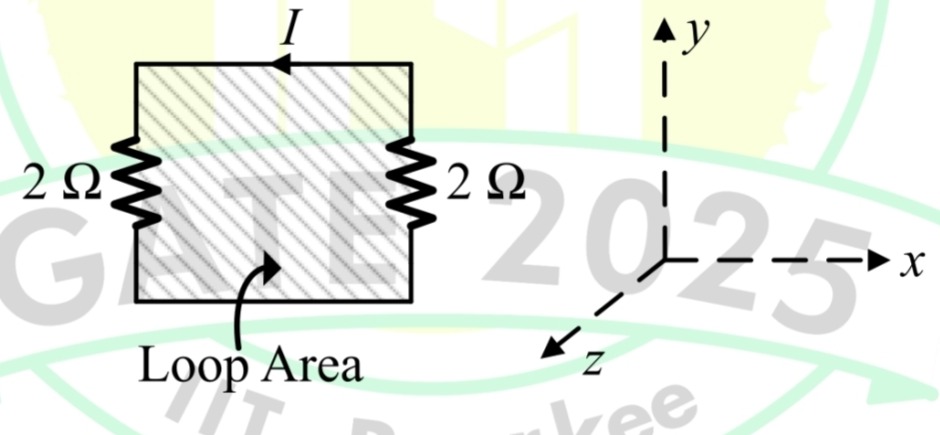 Two resistors are connected in a circuit loop of area 5 m2, as shown in the figure below. The circuit loop is placed on the x-y plane.
When a time-varying magnetic flux, with flux-density B(t)=0.5t (in Tesla), is applied along the positive z-axis, the magnitude of current I (in Amperes, rounded off to two decimal places) in the loop is _______.
A
0.62 to 0.63