Related Questions5 Items
Q1.MCQ
A Boolean function is given as
$f = (\bar{u} + \bar{v} + \bar{w} + \bar{x}) \cdot (\bar{u} + \bar{v} + \bar{w} + x) \cdot (\bar{u} + v + \bar{w} + \bar{x}) \cdot (\bar{u} + v + \bar{w} + x)$
The simplified form of this function is represented by
Q2.MCQ
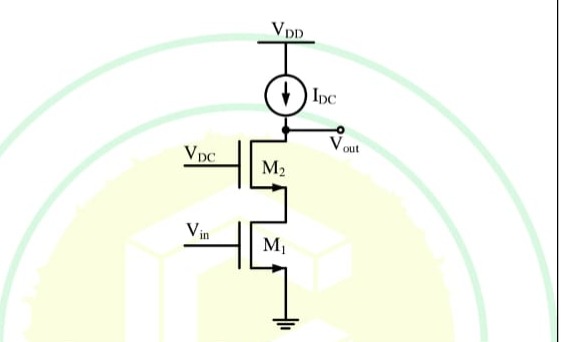
In the circuit, $I{\text{DC}}$ is an ideal current source. The transistors $M1$ and $M2$ are assumed to be biased in saturation, wherein $V{\text{in}}$ is the input signal and $V{\text{DC}}$ is fixed DC voltage. Both transistors have a small signal resistance of $r{ds}$ and trans-conductance of $gm$. The small signal output impedance of this circuit is
!image(https://uadmin.udsfgecw.tech/file/download/public/public:a11836ea-41ec-485d-90cb-c7c81d9d032c.jpg)
Q3.MCQ
In the circuit, shown below, if the values of R and C are very large, the form of the output voltage for a very high frequency square wave input, is best represented by
!image(https://uadmin.udsfgecw.tech/file/download/public/public:6aaedc63-d1af-4d03-9526-8b05415e7c8e.jpg)
Q4.MCQ
Which one of the following statements is true about the small signal voltage gain of a MOSFET based single stage amplifier?
Q5.MCQ
Assuming ideal op-amps, the circuit represents a
image needed to be inserted here
Electrical and Electronic EngineeringAnalog and Digital ElectronicsMultiple Choice (MCQ)2 Marks
Q2.
In the circuit, IDC is an ideal current source. The transistors M1 and M2 are assumed to be biased in saturation, wherein Vin is the input signal and VDC is fixed DC voltage. Both transistors have a small signal resistance of rds and trans-conductance of gm. The small signal output impedance of this circuit is

A
2rds
B
gm1+rds
C
gmrds2+2rds
D
infinity